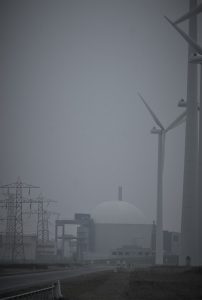
 Nuclear energy has suddenly become relevant again due to the energy crisis. A monster from the previous century is rearing its ugly head again; apparently, we have already forgotten that atomic technology in human hands is equivalent to a loaded revolver in a toddler’s hands. Nuclear energy is like taking out a loan of thirty million euros on a modal income, paying back three thousand, and cheerfully passing the remaining debt on to your descendants.

Nuclear energy: I’ll give you a few good reasons why we should say goodbye to it very quickly. To begin with, recent history has taught us that things can go terribly wrong. Due to human failure, disaster struck in Chernobyl in 1986, in 2011 an earthquake caused Fukushima, and ignorance combined with hasty action led to an almost mega-disaster in Windscale in 1957, later renamed Sellafield. The International Atomic Energy Agency (IAEA) has registered fourteen incidents in the past 65 years, ten of which were serious enough to be qualified as accidents. The life-threatening situation in the Ukrainian Zaporizhzhia proves how risky nuclear energy is in this unstable world. You can bet that accidents with nuclear power plants will continue to happen in the future, especially considering that nuclear technology will increasingly be used in less wealthy and organized countries where they cannot or do not take safety and maintenance seriously, thus increasing the chance of nuclear disasters.
<script async src=”//pagead2.googlesyndication.com/pagead/js/adsbygoogle.js”></script>
<ins class=”adsbygoogle” style=”display: block; text-align: center;” data-ad-layout=”in-article” data-ad-format=”fluid” data-ad-client=”ca-pub-1285622645042453″ data-ad-slot=”8842128382″></ins>
<script>
(adsbygoogle = window.adsbygoogle || []).push({});
</script>
Nuclear Weapons Nuclear energy is excellently suited for weapons of mass destruction. During the height of the Cold War, the US and Soviet Union alone had enough material to destroy our entire planet five hundred (500!) times. I sometimes hear the argument that peaceful nuclear energy and nuclear weapons are completely different things, but that’s nonsense. Playing the piano and organ are also two different disciplines, but if you master one instrument well, you’ll get quite far on the other. In fact, the world’s first large-scale nuclear power plant, Calder Hall in Sellafield, England, was essentially a cover for producing plutonium for the hydrogen bomb and a charm offensive: ‘Electricity too cheap to meter’ was the misleading credo.
Radioactive Garbage Nuclear energy may be CO2-neutral, but it produces waste that makes CO2 look like nothing. We’ve only been messing with nuclear energy for about eighty years, and already there are piles of radioactive garbage deep underground and/or in concrete bunkers in various places around the world that in some cases, such as in Carlsbad, New Mexico, will remain deadly for the next 250,000 years. Note, a quarter of a million years: that’s almost as long as humans have existed. It’s safely stored, nuclear energy proponents say, but what is safe? We have no idea what the world will look like in a thousand years, let alone in 250,000 years. How can you claim something is safe in a future you have no clue about? The storage sites for this deadly mess will remain intact for up to a thousand years, nuclear energy supporters claim. I haven’t found an answer about what happens in the following 249,000 years.
Asocial and Criminal Therefore, nuclear energy is the same as taking out a gigantic loan that you already know your descendants will have to pay for until the end of time. It is extremely selfish, asocial, and therefore criminal. And actually, we already know this, but we are so addicted to our current level of prosperity and so eager for even more that we completely don’t care. After us, the flood.